Wrist Lock
A joint lock that applies pressure to the opponent's wrist joint. This small joint manipulation requires precision but can be applied from many positions for a quick submission.
How to do the Wrist Lock
When to use it
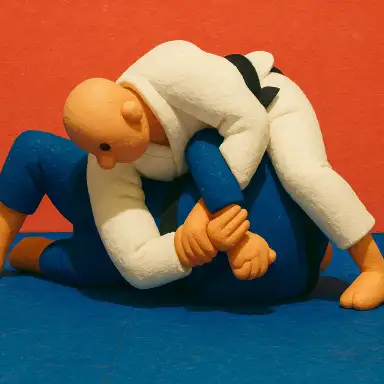
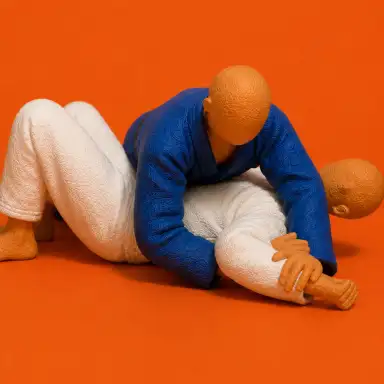
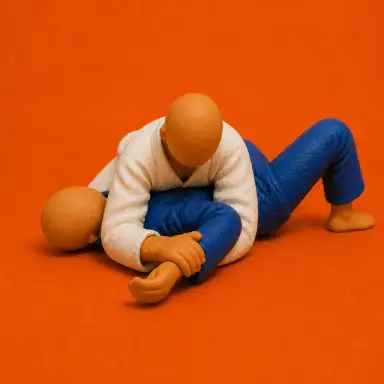
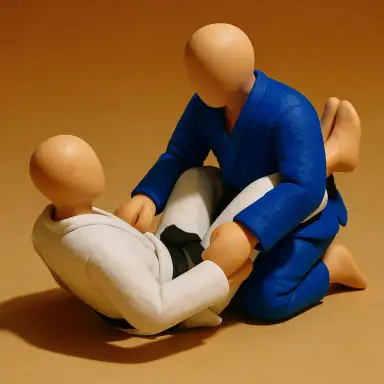
Wrist locks appear when the opponent's hand is pinned with the wrist already bent: a hand posted on your chest in Closed Guard, a frame against your neck from under side control, or an arm caught in a Kimura grip. They work well as a quick follow-up when the opponent defends a bigger arm lock by bending the wrist.
Step by step
- Isolate one arm, for example by trapping the posted hand against your chest or taking a Kimura grip.
- Make sure the wrist is bent toward the inside of the forearm, with the palm facing in.
- Keep the elbow bent and pinned so the opponent cannot straighten the arm to relieve the angle.
- Press on the back of the hand, folding it toward the inner forearm, using your chest, forearm, or both hands.
- Apply pressure very slowly in training; the wrist reaches its limit fast, and the partner taps early.
Key details
- Control the elbow and forearm first; a wrist lock without arm control is easy to slip.
- Push on the back of the hand near the knuckles, not the fingers.
- Treat it as a link between other attacks: if the opponent defends the Kimura, Americana, or Key Lock by bending the wrist, the wrist lock is there.
Common mistakes
- Grabbing only the hand. The opponent straightens the arm and pulls free; trap the forearm and elbow too.
- Pressing on the fingers. That bends fingers instead of the wrist; place pressure on the back of the hand.
- Snapping the finish. The wrist has little warning before injury; apply it slowly and wait for the tap.
How to escape it
- Keep your wrist straight, making a fist with the knuckles in line with the forearm.
- Avoid leaving a bent wrist posted on the attacker's chest or neck; frame with the forearm instead.
- Pull the elbow back toward your body to straighten the angle and free the arm.
- If the wrist is bent and pressure is building, tap early.
Gi vs no-gi
In the gi, opponents who hold collar or sleeve grips keep their wrists bent, which creates more entries; in no-gi the arm slips more, so arm control matters more.
FAQ
- What is the difference between a wrist lock and a Key Lock?
- A Key Lock rotates the shoulder through a bent arm, while a wrist lock bends the wrist itself. The same arm control often sets up both.
- Why do wrist locks feel so sudden?
- The wrist has a short range before the joint is at its limit. That is why the opponent should tap early and the attacker should apply the lock slowly.
Where Wrist Lock connects
Champions who use it
- 1Watch on YouTubeClaudio CalasansBrazil · 5 match clips
- 2Watch on YouTubeMason FowlerUnited States · 4 match clips
- 3Watch on YouTubeFelipe 'Preguiça' PenaBrazil · 1 match clip
- 4Watch on YouTubeVictor HugoBrazil · 1 match clip
- 5Watch on YouTubeAdam WardzińskiPoland · 1 match clip
2 more champions
Filter by weight class and event, and watch every match clip, in the app.
Technique videos


Sequences with this technique
2 sequences
Every step from entry to finish lives in the app's tech tree.
Related techniques

Log this technique in your training journal
Post Black Belt: BJJ Journal
Log BJJ training, track belt & stripes, get AI technique picks and Health sync.