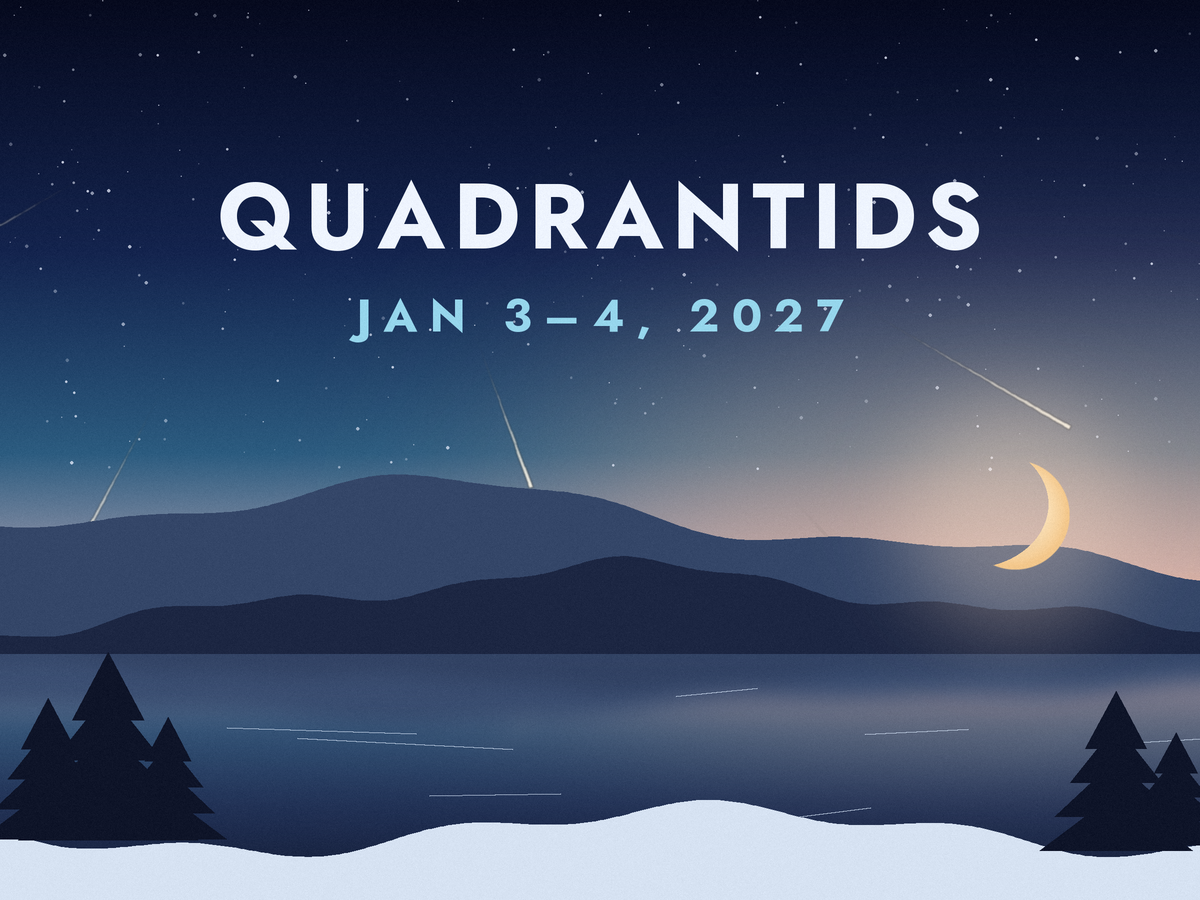
The first meteor shower of the year is the Quadrantids. On a good night it can rival the Perseids and the Geminids, but its peak lasts only a few hours. That makes one question matter more than any other: is it night where you are when the peak arrives?
In 2027 the answer is good news for Europe. The International Meteor Organization (IMO) puts the peak at January 4, 03:25 UT, which is 3:25 AM in London and 4:25 AM in Berlin, with the radiant high and the Moon almost out of the picture. North America and East Asia get a less favorable timing, but the pre-dawn hours are still worth a look. I worked out the times for each city below.
When is the Quadrantid peak in 2027?
According to the IMO 2027 Meteor Shower Calendar, the Quadrantids are active from December 28 to January 12 and peak on January 4 at 03:25 UT, give or take about 2.5 hours. The zenithal hourly rate (ZHR) is listed at 80, but it has varied between about 60 and 200 in recent years.
- London: 3:25 AM, January 4
- Berlin, Paris: 4:25 AM, January 4
- Moscow: 6:25 AM, January 4, just before dawn
- New York: 10:25 PM, January 3
- Los Angeles: 7:25 PM, January 3
- Tokyo, Seoul: 12:25 PM, January 4 (daytime)
The IMO also notes that modeling shows the stream slightly shifted toward the Sun in 2027, which might bring stronger activity. That is a possibility, not a forecast, so I would not plan around it.
Best hours to watch, city by city
A Quadrantid peak in the evening does not help much. The radiant sits low in the north early in the night and only climbs high before dawn. In New York it is just 4° above the horizon at the 10:25 PM peak, and in Los Angeles it is still below the horizon. The chart shows, for the night of January 3 to 4, when the sky is fully dark and when the radiant is at least 20° up.
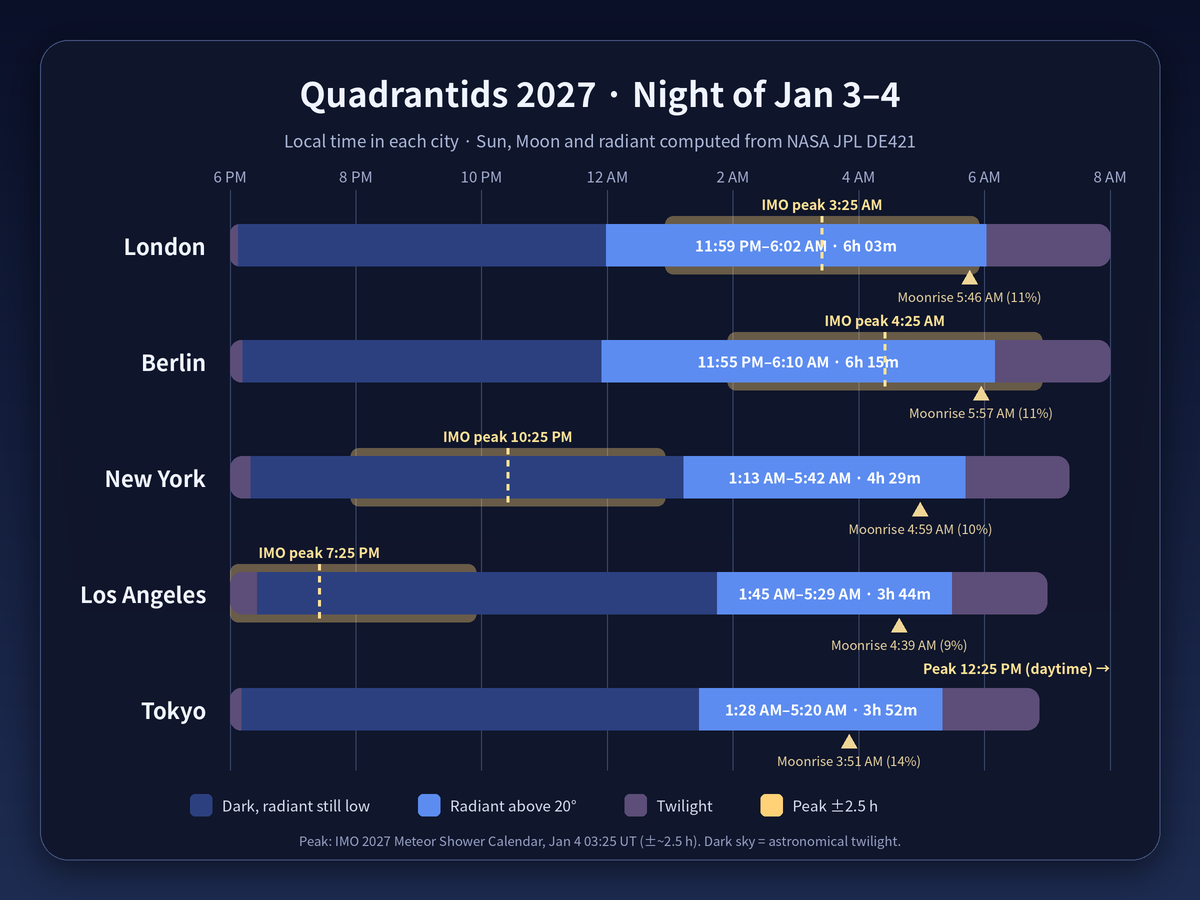
- London: radiant above 20° from 11:59 PM, dark until astronomical dawn at 6:02 AM. The peak at 3:25 AM lands right in the middle, with the radiant about 44° up. This is about as good as it gets.
- Berlin: 11:55 PM to 6:10 AM, peak at 4:25 AM with the radiant about 52° up.
- New York: the peak comes too early. The best hours are 1:13 AM to 5:42 AM, three to seven hours after the peak, so expect lower rates.
- Los Angeles: 1:45 AM to 5:29 AM, six to ten hours after the peak.
- Tokyo: 1:28 AM to 5:20 AM, about seven hours before a daytime peak.
January 4, 2027 is a Monday, so for most people this is a Sunday-night shower. If you can't stay up all night, go to bed early and set an alarm for the last two or three hours before dawn.
The Moon won't get in the way
New Moon falls on January 7 (UT), so on the morning of January 4 the Moon is a thin waning crescent, about 10 to 14% lit depending on where you are. It rises in the east-southeast in the last hour or two before dawn, while the radiant is in the northeast. The IMO calls the lunar conditions perfect this year. Compare that with 2026, when the peak fell next to a full Moon.
Where to look
The radiant lies between the constellation Boötes and the end of the Big Dipper's handle. The shower is named after Quadrans Muralis, an old constellation that used to sit there. Before dawn it is in the northeast and climbing: from London it is about 33° up at 2 AM and 57° at 5 AM.
You do not need to stare at the radiant. Meteors appear all over the sky, and the ones farther from the radiant have longer trails. Lie back with a wide view of the sky, ideally with the northeast open and any lights behind you. Quadrantids enter at about 41 km/s, medium speed, and the shower is known for the occasional bright fireball.

Keep expectations realistic. ZHR 80 assumes a perfectly dark sky with the radiant overhead. The Quadrantid peak is often described as only about four hours wide, so rates drop quickly if you are watching well before or after it. Under suburban skies you will see far fewer.
Dress for a January pre-dawn
The hours before sunrise are the coldest part of the night, and you will be lying still. A camping mat to cut the cold from the ground, a sleeping bag on top, hand warmers for your feet, a thermos, and a red flashlight are worth bringing. Turn your phone brightness all the way down; your eyes need about 15 minutes to adapt to the dark.
Check your own dark-sky hours in the app
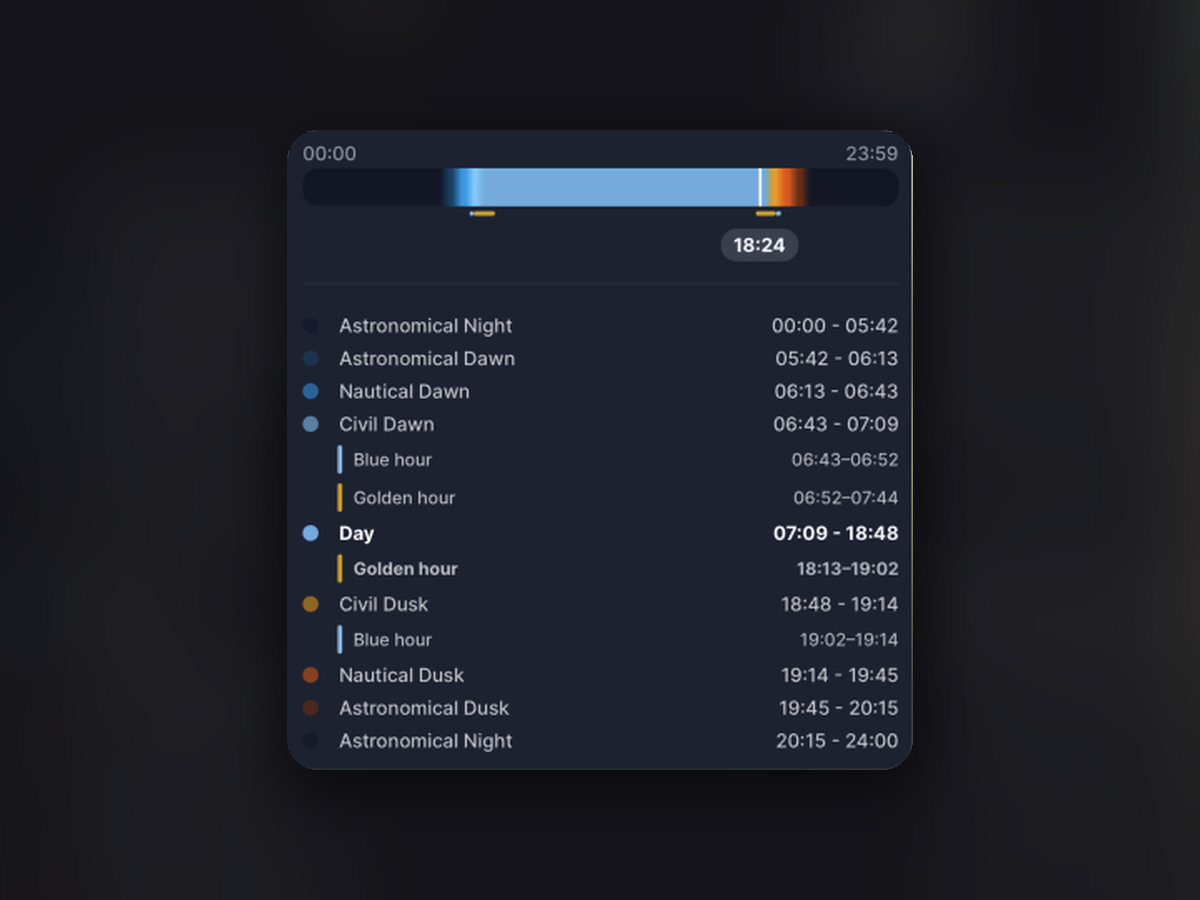
The chart uses city centers. If you drive out to a darker site, check that location instead. In Golden Horizon, I set the date to January 4, pick the spot, and read the start of astronomical dawn on the light timeline. After that the sky starts to brighten, and the fainter meteors disappear first.
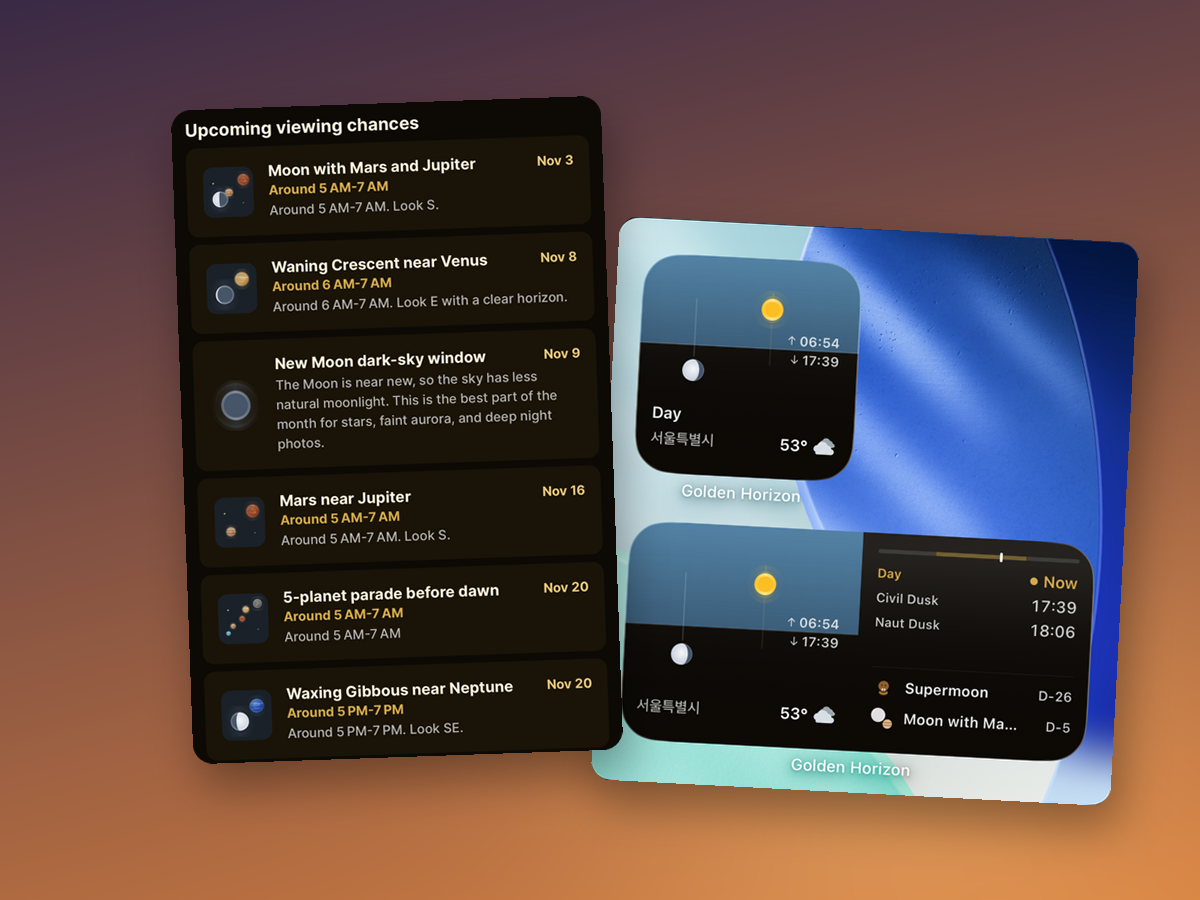
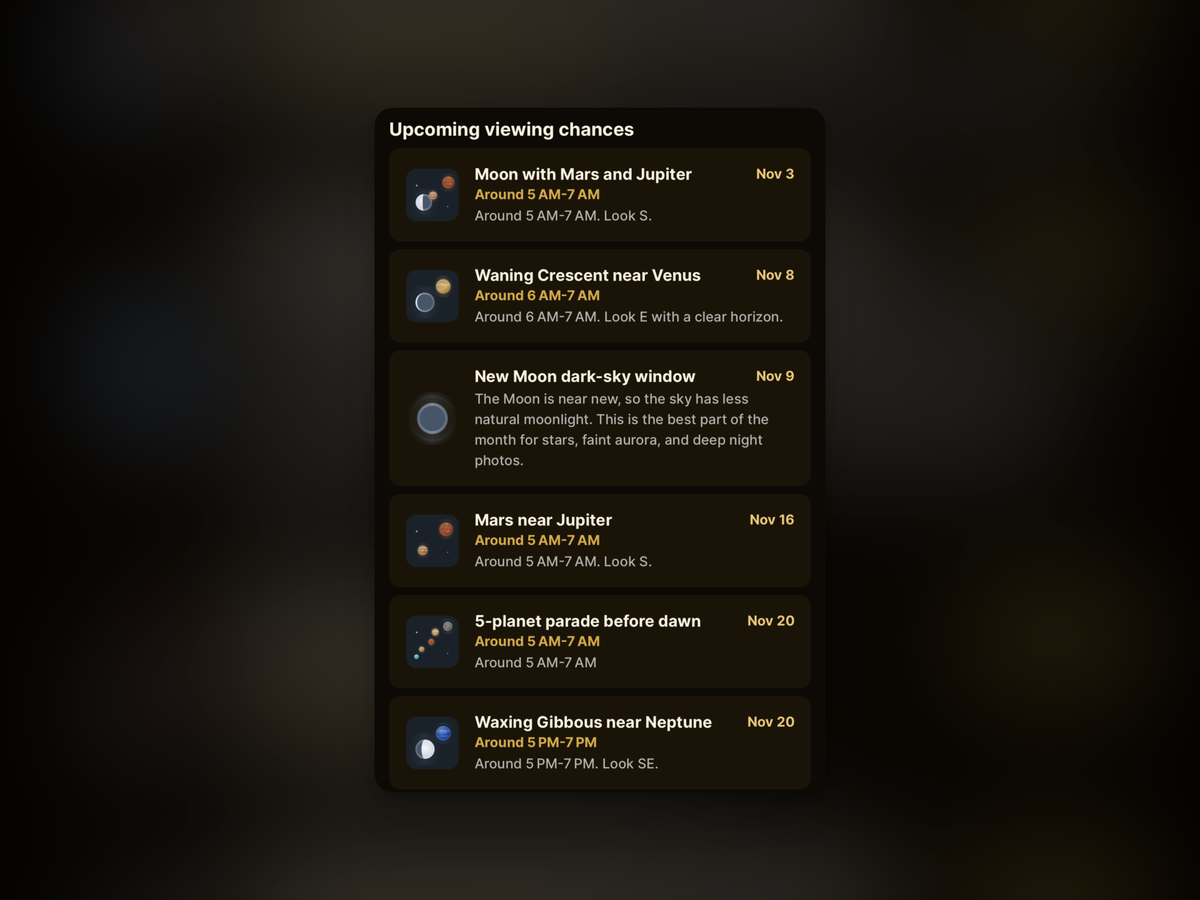
The sky events list shows upcoming viewing chances with a time window and direction, so you can catch a planet or the crescent Moon on the same morning.
Photographing the Quadrantids
Put a wide-angle lens on a tripod and run an intervalometer at 15 to 20 seconds per frame. Include the northeast sky but keep the radiant near the edge of the frame, so meteors streak across it. Cold pre-dawn air frosts lenses quickly; a lens heater or a hand warmer strapped around the barrel helps. Keep spare batteries in an inner pocket.
When the meteors fade with the dawn, stay a little longer. The thin crescent Moon low in the east-southeast makes a nice end to the night. For planning early light, see the golden hour photography guide.
FAQ
When is the best time to see the Quadrantids in 2027?
The pre-dawn hours of Monday, January 4. In Europe that includes the peak itself, around 3:25 AM in the UK and 4:25 AM in Central Europe. In North America, watch from about 1 AM until the first light of dawn.
How many meteors will I see?
Far fewer than the ZHR of 80. That number assumes ideal conditions at the peak. From a dark site in Europe near the peak you have the best chance; elsewhere, and under suburban skies, expect noticeably fewer.
Can I watch on January 3 or January 5 instead?
You can, but both mornings are about a day from the peak, and the Quadrantids fade fast. If January 4 is cloudy, the morning of January 5 is the backup.
January has one more sky event worth marking: the full Moon on January 22 is the first supermoon of 2027. The last one of 2026 is the December 24 Cold Moon. And if you missed December's big shower, the Geminids guide covers it.
Sources
- International Meteor Organization — 2027 Meteor Shower Calendar: activity period, peak time and uncertainty, ZHR, speed, radiant, Moon conditions
- Moonrise, astronomical twilight, radiant altitude and direction, Moon illumination and New Moon date: computed from the NASA JPL DE421 ephemeris (Skyfield)
Photo credit
- Esperando a que cayeran las Cuadrántidas (Waiting for the Quadrantids), Eneas De Troya, CC BY 2.0, resized with a background added