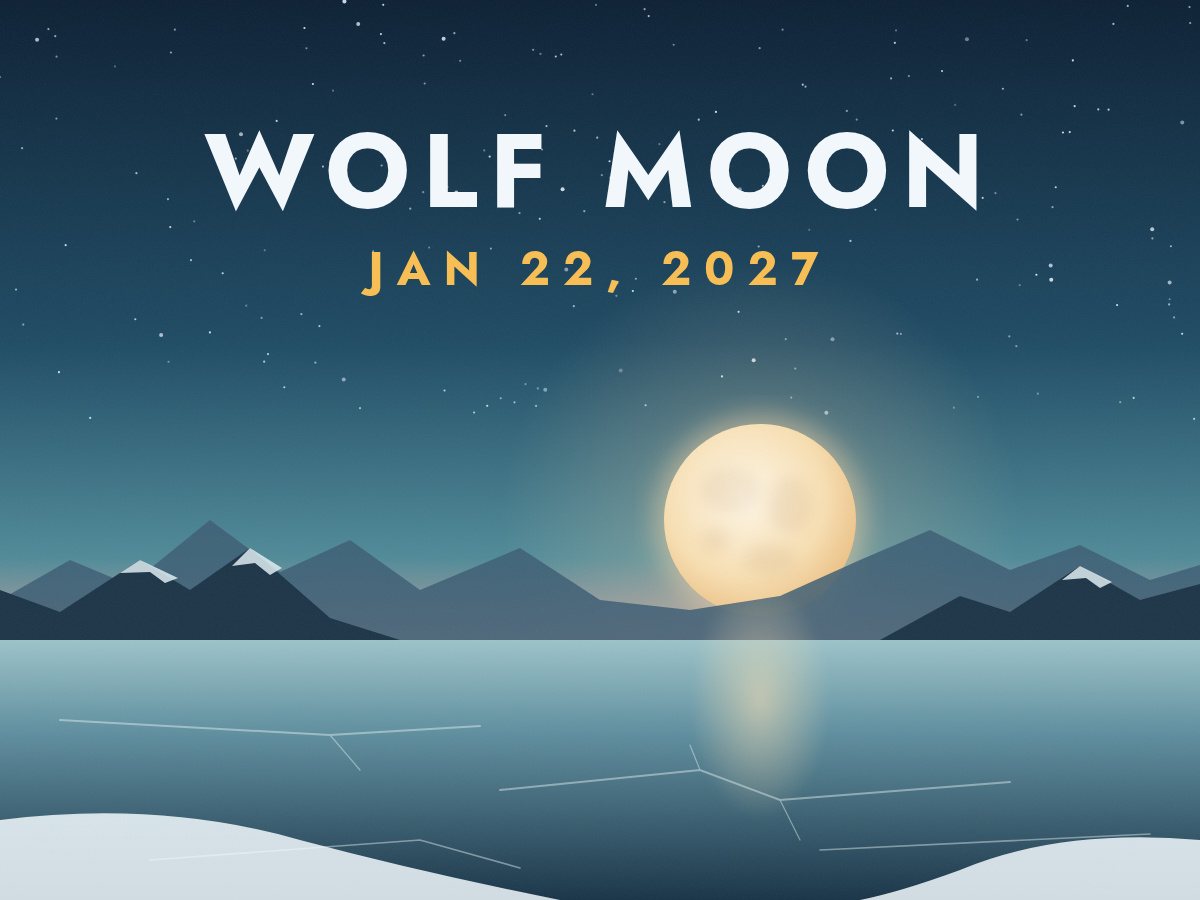
The first full moon of 2027 rises on Friday, January 22. Of the twelve full moons in 2027, it's the closest to Earth, which makes it the biggest full moon you'll see next year. In North America the January full moon is called the Wolf Moon. It's exactly full at 12:17 UTC on January 22, which is 7:17 AM EST and 4:17 AM PST.
Short version: Seoul, Tokyo, and London get the best moonrise on the evening of January 22, when the Moon clears the horizon during golden hour. New York gets a blue-hour moonrise on the 22nd, and Los Angeles should go out on January 21. I computed the moonrise times for each city below.
Supermoon dates for 2027
I computed the distance of all twelve 2027 full moons. January 22 is the closest at about 357,644 km (222,230 miles), followed by February 20 (about 363,306 km). From March on they drift farther out, with the most distant full moon on July 18 (about 405,979 km).
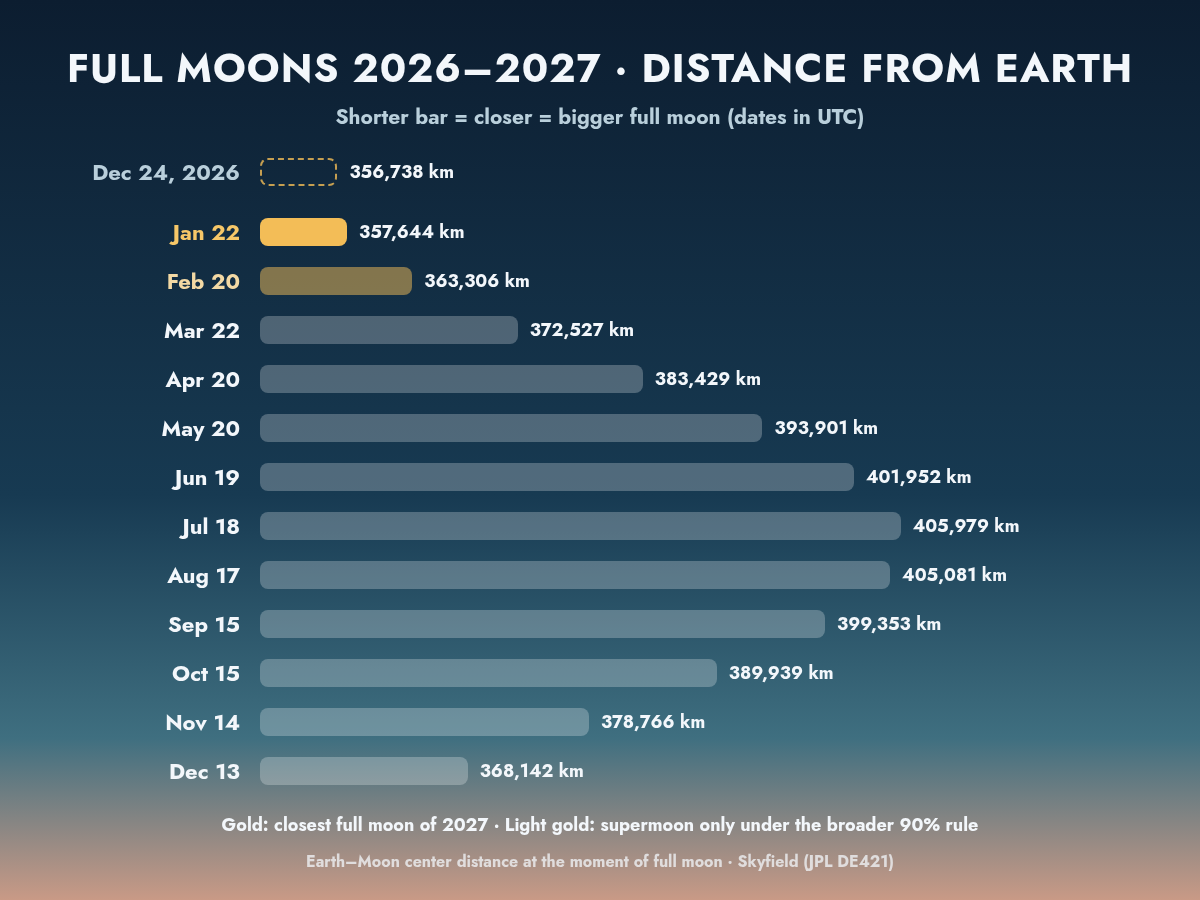
There's no official definition of a supermoon. If you use a simple distance cutoff (about 360,000 km or closer), 2027 has one supermoon: January 22. If you use the broader rule, a full moon within 90% of its closest approach for that orbit, the February 20 Snow Moon counts too, for two. The December 13 full moon misses even the broader rule by a few dozen kilometers.
Compared with the July full moon, the January 22 Moon looks about 14% wider and about 29% brighter. Perigee comes about 14 hours before the moment of full moon, at roughly 21:50 UTC on January 21.
How it compares with the December supermoon
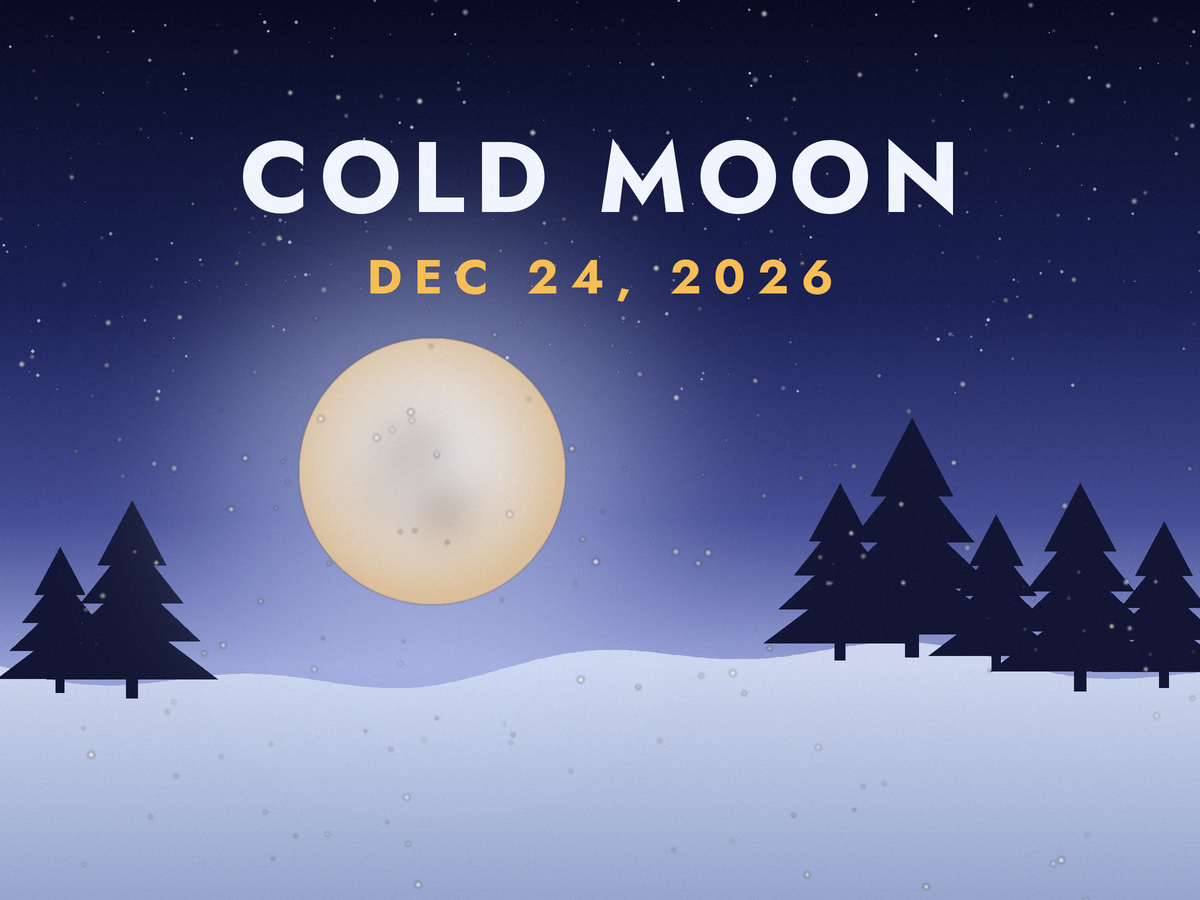
The December 24 supermoon was about 356,738 km away. January 22 is only about 900 km farther, a difference of less than 0.3% in apparent size. To the eye they're the same. That's two nearly identical big full moons one month apart.
If Christmas Eve was cloudy or you were busy, January 22 is effectively your second chance, and this time it falls on a Friday evening. If you want the Moon to look big, though, the number matters less than where you see it: low on the horizon, next to something in the landscape.
Moonrise times and golden hour by city
Same definitions as in my earlier posts: golden hour is when the Sun is between 6° above and 4° below the horizon, blue hour between 4° and 6° below. All times are local.
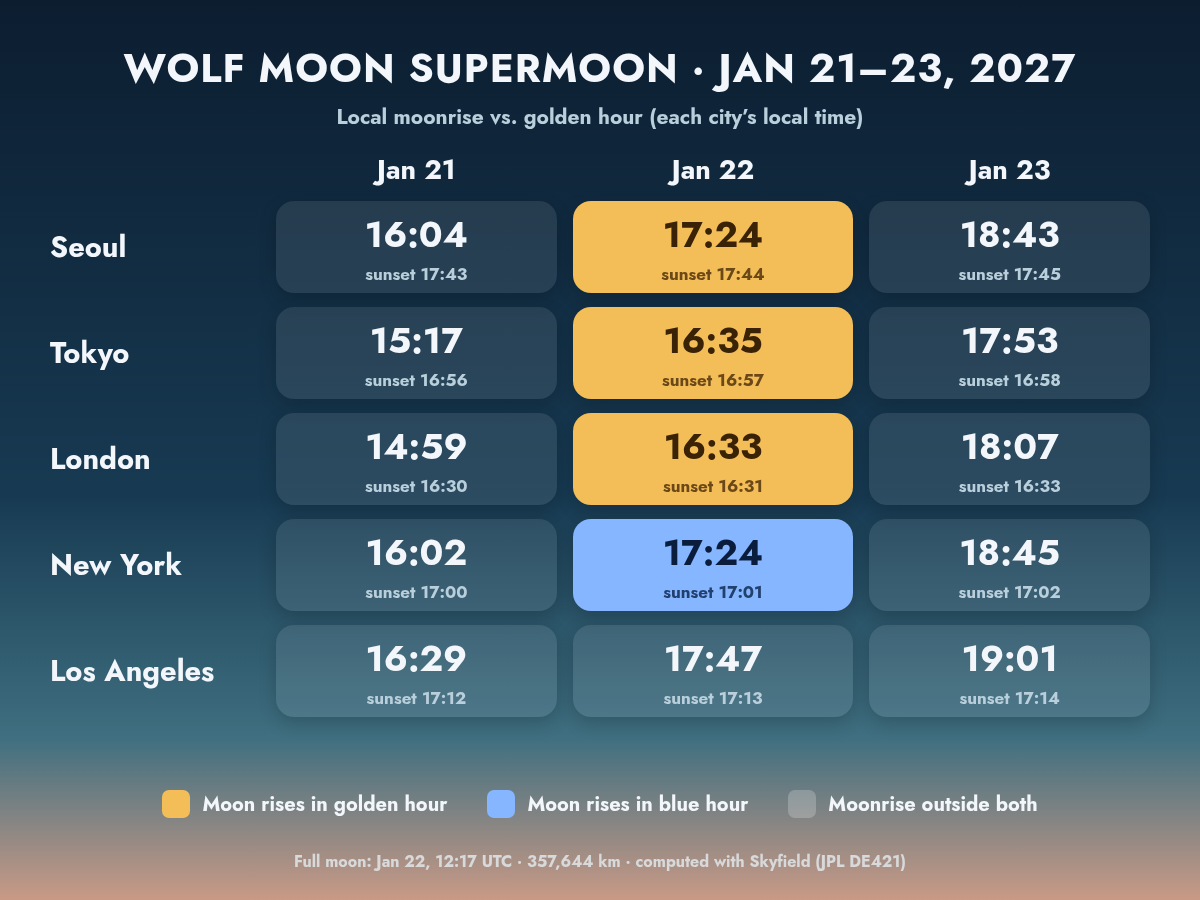
- Seoul: January 22, moonrise 17:24, sunset 17:44. The Moon comes up in the middle of golden hour (17:05–18:01).
- Tokyo: January 22, moonrise 16:35, sunset 16:57. The Moon is up about 20 minutes before the Sun goes down.
- London: January 22, moonrise 16:33, sunset 16:31. Sun and Moon sit on opposite horizons at almost the same minute.
- New York: January 22, moonrise 5:24 PM, sunset 5:01 PM. It rises during blue hour (5:19–5:30 PM). For warm light on the landscape, go out on January 21 instead: the Moon rises at 4:02 PM and is already low in the sky when golden hour starts at 4:18 PM.
- Los Angeles: January 21, moonrise 4:29 PM, sunset 5:12 PM. Golden hour starts at 4:35 PM, so the Moon is up for all of it. On the 22nd it rises at 5:47 PM, after blue hour ends (5:40 PM).
The exact full moon happens on the morning of January 22 in the Americas (7:17 AM in New York, 4:17 AM in Los Angeles), so both the January 21 and January 22 evening moons are more than 99% lit there. In East Asia the full moon moment comes a few hours after moonrise on the 22nd, so that night's Moon is the fullest it gets.
Which direction the Moon rises
From Seoul on January 22, the Moon rises at an azimuth of 62°, east-northeast. The Sun sets almost directly opposite, at 246° in the west-southwest. That's a little farther east than on December 24 (55°), so if you reuse last month's spot, the Moon will come up a bit to the right of where it did.
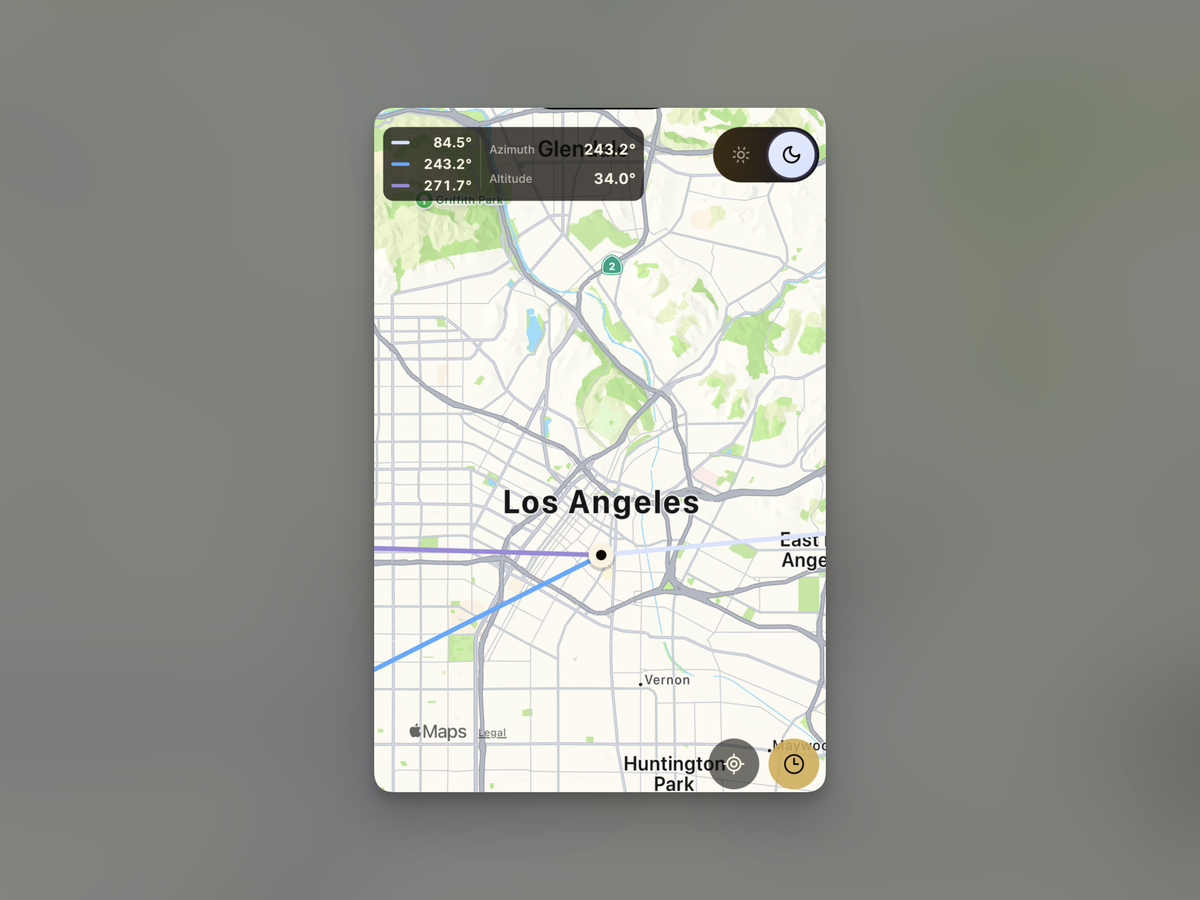
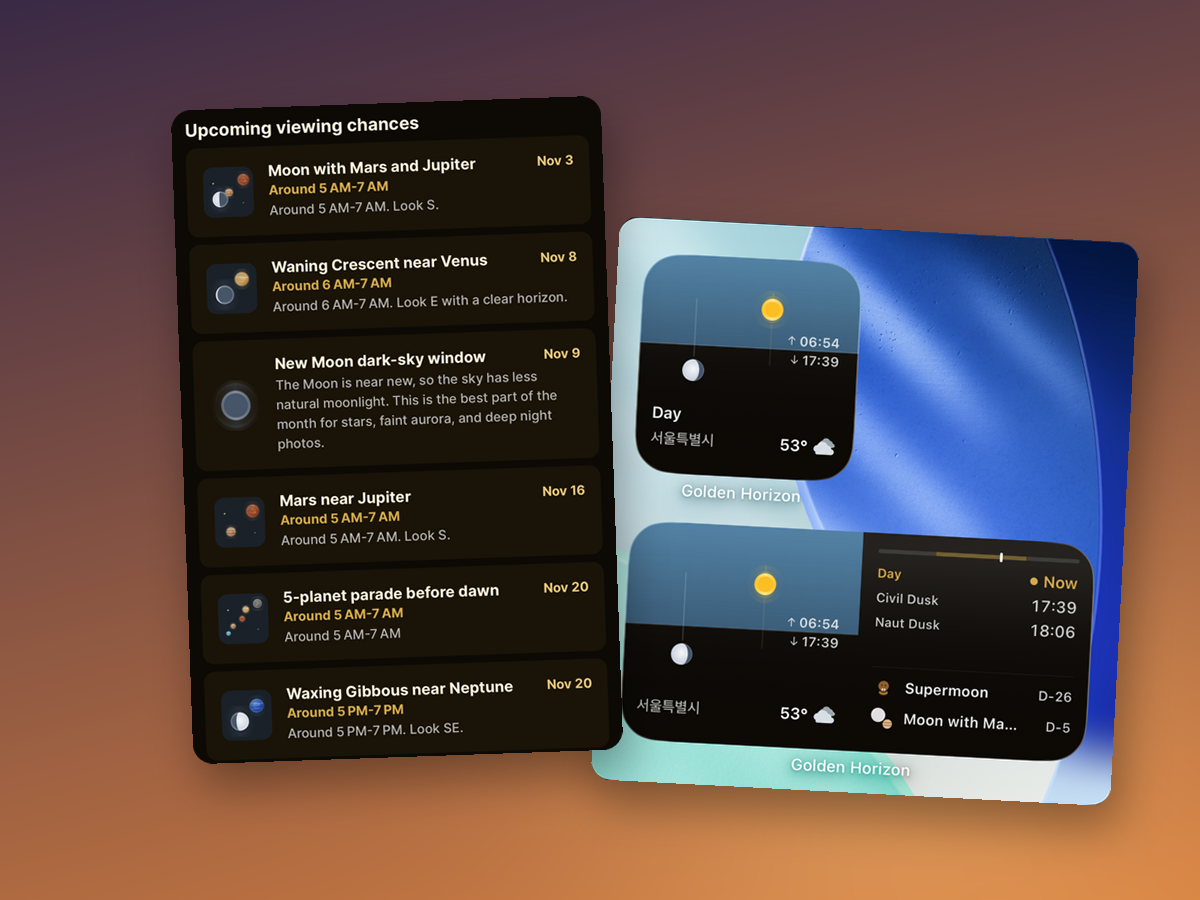
I set the date first in Golden Horizon's moon direction map, then check whether a building or ridge I want in the shot sits on the moonrise line. If the subject and my position line up along it, I'm set. If you're going back to a December location, check how far the line has moved first.
A midwinter full moon rides high
Winter full moons climb as high as the summer Sun. By my calculation, the Moon reaches about 73° above the horizon from Seoul around 00:55 on January 23, and about 66° from New York around the same local time.
So for the Moon with a landscape, shoot right after moonrise. For close-ups of the lunar surface with a long lens, wait until around midnight. The higher the Moon, the less atmosphere you shoot through, and the sharper the surface looks.
Tips for a January moonrise
- The first 20 minutes matter most. In Seoul, blue hour ends at 18:12 on the 22nd. After that the sky goes dark fast and the Moon turns into a bright white disc.
- Find an open east-northeast horizon. If a building or hill blocks the low Moon, you lose the best 10–20 minutes.
- Back up and zoom in. The farther you stand from your subject, the larger the Moon looks next to it.
- Plan for the cold. Keep spare batteries in an inside pocket and wear gloves that work with a touchscreen.
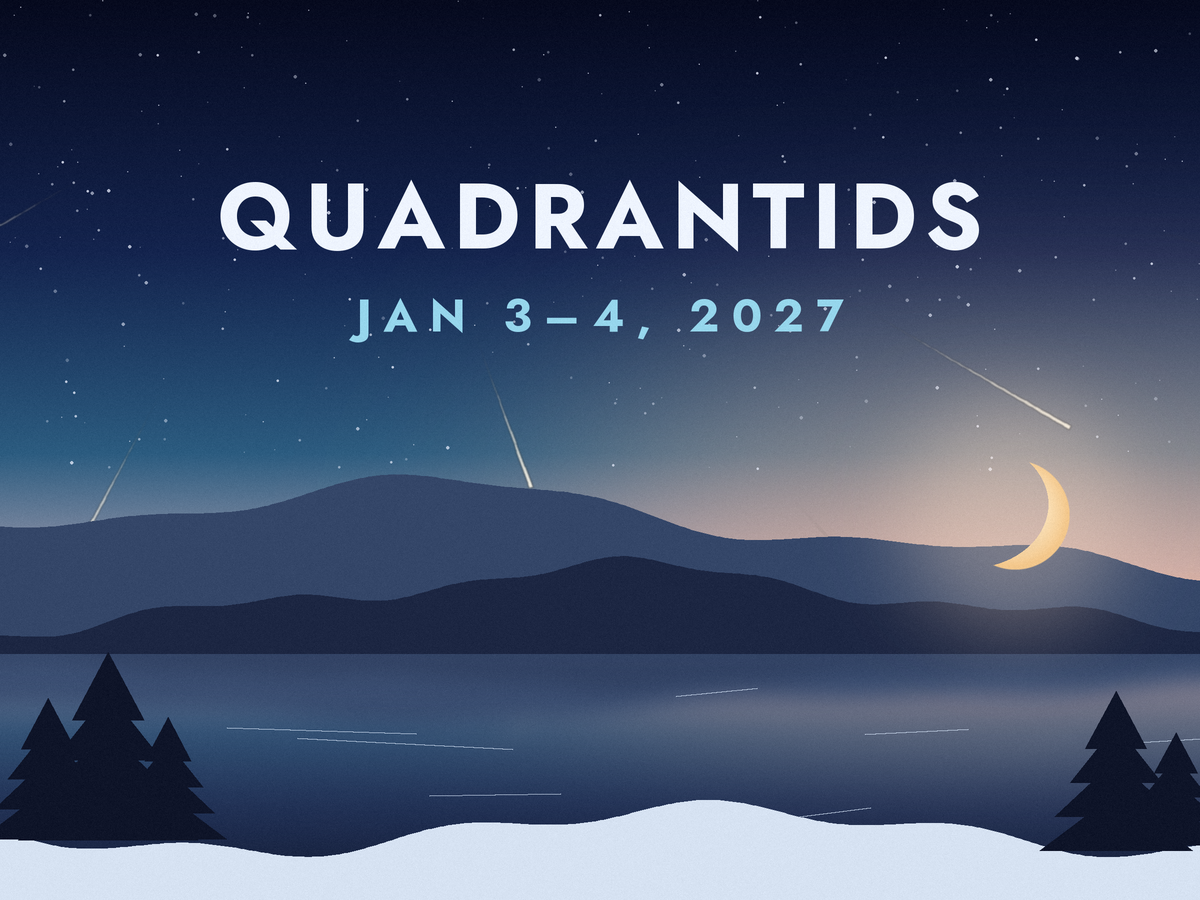
For planning golden-hour shots in general, see A Photographer's Guide to Perfect Golden Hour Shots. To check moon events like supermoons in the app, see Check Planet, Blue Moon, and Solar Eclipse Events. Earlier the same month, the Quadrantid meteor shower peaks too.
Summary
The January 2027 supermoon is the Wolf Moon on January 22, the closest full moon of 2027. Seoul, Tokyo, and London see it rise in the east-northeast during golden hour on the 22nd. New York gets a blue-hour moonrise that evening, and Los Angeles does best on the 21st. The next-closest full moon is February 20. On Friday evening, take a minute to look east.
Sources
- timeanddate — New York Moonrise and Moonset, January 2027: moonrise times and azimuths for comparison
- The Old Farmer's Almanac — What Is a Supermoon?: supermoon definitions
- Moon Phase Software — Supermoon 2027: 2027 perigee and full moon distances